
SABR TREATMENT FOR LYMPH NODE METASTASES IN THE UK
Targeted Radiotherapy
For Cancer Affecting
The Lymph Nodes
When cancer spreads to a lymph node, it does not always mean that systemic treatment is the only option. For patients with a limited number of involved nodes and disease that is otherwise controlled, SABR offers a direct, non-surgical way to treat each site precisely.
Lymph node metastases occur across many cancer types and in several different anatomical regions. Where the node is clearly defined and the surrounding anatomy allows safe dose delivery, SABR may support the wider treatment plan by treating the affected site directly.
Non-Surgical Local Treatment
Treatment is delivered externally with no incision or inpatient admission.
Short Treatment Course
Each session is attended as an outpatient appointment with no overnight stay.
Compatible With Drug Treatment
The short treatment course minimises disruption to ongoing systemic therapy.
WHAT ARE LYMPH NODE METASTASES?
What It Means When Cancer Is Found In The Lymph Nodes
Cancer cells can enter the lymphatic system and travel to nearby or distant lymph nodes, where they may establish secondary deposits. This is one of the most common patterns of cancer spread and does not in itself indicate that disease is widespread or untreatable.
The clinical significance of lymph node involvement depends on which nodes are affected, how many are involved and what the primary cancer is doing elsewhere.
A single affected node in an otherwise controlled disease picture presents different treatment considerations from multiple nodes across several regions.
Symptoms Of Lymph Node Metastases
- A lump or swelling that is firm, persistent and does not resolve
- Swelling in the arm or leg if lymphatic drainage is obstructed
- Unexplained persistent pain in the neck, armpit, groin or abdomen
- Shortness of breath if nodes in the chest are involved
- Abdominal discomfort or bloating from enlarged abdominal nodes
- Recurrent infections if immune drainage is disrupted
- Unexplained fatigue or unintended weight loss
- Difficulty swallowing where nodes press against the oesophagus
Many are found on routine staging scans rather than through symptoms alone.
The main types of Lymph Metastases
Cervical Lymph Node Metastases
Cancer has spread to lymph nodes in the neck. These nodes drain the head, neck and thyroid and are commonly involved in head and neck, thyroid and lung cancers.
Axillary Lymph Node Metastases
Cancer has spread to lymph nodes in the armpit. This is most commonly associated with breast cancer but can occur with melanoma and lung cancer.
Mediastinal Lymph Node Metastases
Cancer has spread to nodes in the chest between the lungs. These are frequently involved in lung cancer and can cause breathlessness or chest discomfort when enlarged.
Retroperitoneal Lymph Node Metastases
Cancer has spread to nodes in the abdomen behind the peritoneum. These are associated with testicular, kidney, colorectal and gynaecological cancers.
Pelvic Lymph Node Metastases
Cancer has spread to nodes within the pelvis. Prostate, bladder, colorectal and cervical cancers are among the most common primary sources.
Cancers That Spread To the lymph nodes
Lymph node metastases can arise from almost any solid tumour. Each primary cancer tends to spread first to the nodes that sit closest within its lymphatic drainage pathway, which is why the location of the primary tumour largely predicts which nodal regions are most likely to be affected.
Understanding which nodes are involved and why is an important part of staging and treatment planning.
- Prostate cancer
- Breast cancer
- Lung cancer
- Colorectal cancer
- Melanoma
- Kidney cancer
- Bladder cancer
- Head and neck cancers
TREATMENT OPTIONS FOR LYMPH NODE METASTASES
What Treatments Are Available For Lymph Node Metastases
Treatment for lymph node metastases depends on the number of nodes involved, their location, the primary cancer type and how the wider disease is being managed.
Some treatments aim to control the affected nodes directly. Others address the disease systemically or combine both approaches.
Stereotactic Radiotherapy (SABR)
SABR may be considered for selected patients with a limited number of affected nodes, particularly where focused local treatment supports the wider management plan or where one node is progressing while other disease remains controlled.
Conventional Radiotherapy
Standard radiotherapy may be used to treat a nodal region, particularly where multiple adjacent nodes are involved or where a broader field of treatment is more appropriate than a focused approach.
Surgery
Surgical removal of affected lymph nodes may be considered depending on the nodal region, the primary cancer type and whether complete resection is technically feasible and clinically appropriate.
Systemic Cancer Treatment
Chemotherapy, immunotherapy, targeted therapy or hormone therapy may be used depending on the primary cancer type, the molecular profile of the disease and the extent of nodal involvement.
WHAT IS SABR TREATMENT FOR LYMPH NODE METASTASES
Targeted Radiotherapy Planned Around Each Affected Lymph Node
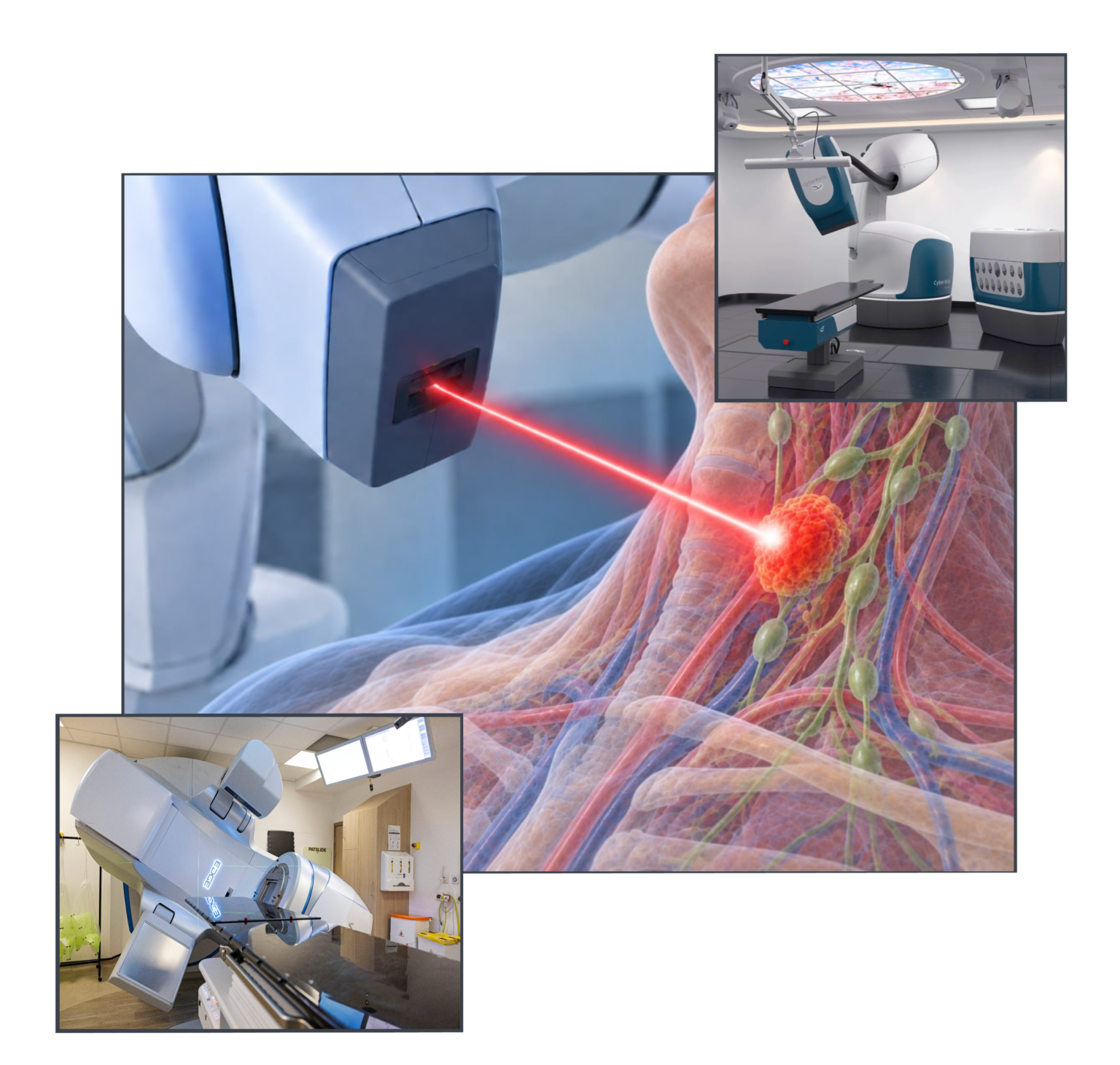
SABR delivers a precise, ablative dose of radiotherapy to individual lymph node metastases using advanced imaging to define each target before treatment begins. The dose is concentrated on the affected node, limiting exposure to the surrounding healthy tissue and adjacent organs.
The critical structures that need to be protected vary depending on the nodal region. Mediastinal nodes sit close to the heart, esophagus, and spinal cord.
Retroperitoneal and pelvic nodes are adjacent to the bowel, kidneys and major vessels. Each plan is built around the specific anatomy of the patient being treated.
- CyberKnife: robotic delivery from multiple angles with real-time positional verification
- Linear Accelerator (Linac): image-guided beams shaped to the contour of each target node
- MR-Linac: real-time MRI guidance providing detailed soft tissue contrast
THE BENEFITS OF SABR FOR LYMPH NODE METASTASES
What SABR Offers For Lymph Node Metastases
For lymph node metastases, SABR is most relevant when the number of affected nodes is limited, each can be clearly identified on imaging and treating them directly serves a specific purpose within the wider management plan.
The benefit is not simply convenience. A focused, ablative dose can be delivered to an individual node while keeping exposure to the surrounding bowel, spinal cord, oesophagus and vascular structures within accepted safety limits. This level of precision is not consistently achievable with conventional nodal radiotherapy.
Because treatment is completed over a small number of sessions, it can often be coordinated around ongoing systemic therapy without requiring a significant pause.
- Treats The Node Without Surgery
Lymph node dissection is not required. Treatment is delivered entirely from outside the body.
- Anatomy-Specific Planning
The structures at risk vary by nodal region and are mapped individually for every patient before treatment begins.
- Preserves Effective Systemic Treatment
Targeting a single progressing node may delay the need to change a drug treatment that is working elsewhere.
- Ablative Dose To The Target
The dose delivered to the node is higher and more focused than conventional palliative nodal radiotherapy.
- Short Outpatient Course
Treatment is typically completed in three to five planned outpatient sessions.
- Compatible With Ongoing Therapy
SABR can usually be delivered without stopping targeted treatment, immunotherapy or chemotherapy.
IS SABR RIGHT FOR YOU
Factors That Make Lymph Node Metastases Suitable For SABR
SABR is not appropriate for every lymph node metastasis. The decision depends on the nodal region involved, the number of affected nodes, and whether the anatomy supports safe dose delivery around adjacent structures.
- A Single Node Has Recurred After Initial Treatment
Focused radiotherapy may achieve lasting local control without changing the wider treatment plan.
- One Node Is Growing While Others Stay Controlled
Treating it directly may mean staying on a drug treatment that is working everywhere else.
- The Node Is Causing Discomfort Or Pressure
Direct treatment may relieve pain or pressure when an affected node presses on nearby tissue.
- Surgery In That Region Carries Too Much Risk
Some nodal sites, particularly in the chest or abdomen, are not easily accessed surgically.
- The Node Is Clearly Visible On PET-CT
A well-defined, active node confirmed on functional imaging is needed before a treatment plan can be built around it.
- The Node Sits Away From Sensitive Structures
Treatment is simpler when the node is away from the bowel, spinal cord and major blood vessels.
SIDE EFFECTS OF SABR FOR LYMPH NODE METASTASES
Possible Effects After Targeted Nodal Radiotherapy
Treatment is delivered without discomfort. The side effects that follow are determined by the location of the treated node and reflect the dose received by adjacent structures rather than the lymph node itself.
Short-Term Effects
- Fatigue in the first weeks after treatment
- Mild localised discomfort at or near the treated site
- Nausea where abdominal or pelvic nodes are treated
- Temporary skin reaction along the treatment path
- Oesophageal discomfort if mediastinal nodes are treated
Longer-Term Effects
- Loose stools or bowel changes after abdominal or pelvic treatment
- Narrowing of the ureter in a small number of patients
- Swallowing difficulties after mediastinal treatment
- Swelling in the arm or leg if lymphatic drainage is affected
- Higher risk of late effects where the area has been previously irradiated
Most side effects are mild and manageable. Any new or worsening symptoms after treatment should be reported to the clinical team promptly.
If you have private health insurance, your policy may cover some or all of your treatment. We are recognised by major UK insurers.
- AXA
- BUPA
- WPA
- Aviva
- Vitality
- Cigna
For self-funding patients, treatment timing is agreed directly with the team. Costs are provided in advance, so you know what to expect.
- Time To Decide
- No Hidden Fees
- Klarna Accepted
Patients travelling to the UK can be supported with scan review, appointments and treatment scheduling.
- Video Consultation
- Scan Review
- Treatment Scheduling
Your SABR Treatment Payment Options
Your Options For Accessing Private SABR Treatment
Private SABR care should be simple to understand before you make any decision. We work with major UK private health insurers, welcome self-funding patients, and support international patients seeking specialist treatment.
Once your case has been reviewed and your treatment recommendation is clear, the team will explain the relevant costs, payment options and next steps.
Getting started
From First Review To Focused SABR Treatment
The process is designed to help you understand what happens next, what needs to be reviewed and how treatment is planned.
Use the form, phone or email to send your enquiry. No referral is needed and the team will respond within one working day to help you understand your options.
Speak with a SABR specialist face to face or by video. They will review your case, explain your options and give you a direct assessment before any decision is made.
Any additional imaging is organised at this stage, giving the team everything needed to plan treatment accurately before proceeding.
Using 4D CT planning, your treatment is mapped around the exact position and movement of the tumour. The completed plan is reviewed by the clinical team before any treatment begins.
Treatment is delivered as a short outpatient course. The number of sessions is planned around your diagnosis, treatment area and the wider care you are receiving
Treatment takes place over one to eight sessions, each delivered as a short outpatient appointment. The process is painless and most patients drive themselves home the same day.
How long does the planning process take before treatment can start?
Typically one to two weeks from the point of receiving your imaging. The timeline depends on whether new scans are needed or existing imaging is sufficient to begin planning.
Is there a risk that treating one node will cause cancer to spread elsewhere?
There is no clinical evidence that SABR to a lymph node causes cancer to spread to new sites. This concern is not supported by published data on SABR for oligometastatic disease.
Can SABR treat multiple lymph node regions at the same time?
In some cases, yes. This depends on the number of sites, their locations and whether each can be safely planned without exceeding cumulative dose limits.
Will I need to stop my current cancer treatment before lymph node SABR?
This depends on the specific drug. Some treatments can continue without interruption. Others require a short pause. Your oncologist will advise based on your individual regimen and the nodal region being treated.
What happens if new lymph node metastases appear after treatment?
New nodal disease is reassessed at the time it is identified. If the number of sites remains limited and each can be safely targeted, further SABR may be considered. Each situation is reviewed individually.
Frequently Asked Questions
We Know You Have Questions. Here Are The Honest Answers.
When you are facing cancer treatment, every question matters. The answers below cover what patients most often ask us, but they are only a starting point.
If you are unsure about anything, our team will take the time to understand your situation, explain things clearly and help you feel more informed about your options.
Speak to the Team
Connect With Our Clinical Team
Whether you have a specific question or simply want to understand your options, our team will provide clear guidance and an honest assessment of what treatment could look like for you.
You can reach us by filling in the contact form or calling us directly.