
SABR for colon cancer in the UK
A precision radiotherapy for primary and Metastatic Colon Cancer
A stage 4 colon cancer diagnosis can leave you feeling that there are no further options to explore, especially if surgery is not possible or you have been offered treatment focused only on managing symptoms.
SABR is a targeted radiotherapy treatment used for selected people with colon cancer that has spread. We provide a careful, honest assessment of whether SABR treatment could be relevant to you.
Primary and secondary cancer
Outpatient Treatment, No Hospital Stay
1 To 5 Treatment Sessions
WHAT IS Colon CANCER?
Understanding your diagnosis before deciding on treatment
Colon cancer begins in the large bowel, usually developing from a growth called a polyp on the inner lining. When it is confined to the colon, surgery is usually the main treatment, often removing the affected section along with nearby lymph nodes.
Colon cancer can spread beyond the bowel, most often to the liver, and sometimes to the lungs, lymph nodes or lining of the abdomen. This is known as metastatic, or stage 4, colon cancer.
Not every diagnosis follows the same path. When the disease is confined to a small number of sites, there may be more room to consider treatment aimed directly at those areas.
Common symptoms of colon cancer
- Rectal bleeding or blood in the stool
- A persistent change in bowel habit
- Abdominal pain or cramping
- Abdominal bloating or a palpable lump
- Unexplained weight loss
- Fatigue or breathlessness, often linked to anaemia
- Dark or black stools
The main types of Colon cancer
Adenocarcinoma
Mucinous adenocarcinoma
Signet ring cell carcinoma
Types Of Secondary Colon Cancer
- Lung cancer
- Breast cancer
- Ovarian cancer
- Prostate cancer
- Kidney cancer
- Melanoma
colon CANCER TREATMENT OPTIONS
Your treatment options for primary and Metastatic colon tumours
Stereotactic Radiotherapy (SABR)
SABR delivers radiotherapy to a colon tumour in a small number of high-dose sessions. Beams are shaped to converge precisely on the tumour, sparing the surrounding bowel and nearby organs.
Endoscopic Resection
For very early-stage tumours confined to the lining of the bowel, small growths can sometimes be removed during colonoscopy, without the need for open or laparoscopic surgery.
Colectomy
Surgical removal of the affected section of colon, along with nearby lymph nodes, is the main treatment for colon cancer confined to the bowel. It can be performed as open or laparoscopic (keyhole) surgery, and is usually curative when the tumour is fully removed.
Colonic Stenting
When a tumour is causing a blockage, a stent can be placed to relieve the obstruction. This may be used to stabilise the bowel before surgery, or as a longer-term option when surgery is not suitable.
Systemic Treatment
Chemotherapy is commonly used after surgery to reduce the risk of recurrence in higher-risk cases, or as the main treatment where the cancer cannot be fully removed. Targeted therapy and immunotherapy may also have a role, depending on the tumour's molecular features.
WHAT IS SABR TREATMENT FOR colon CANCER
A Focused Alternative To Surgery For Colon Cancer
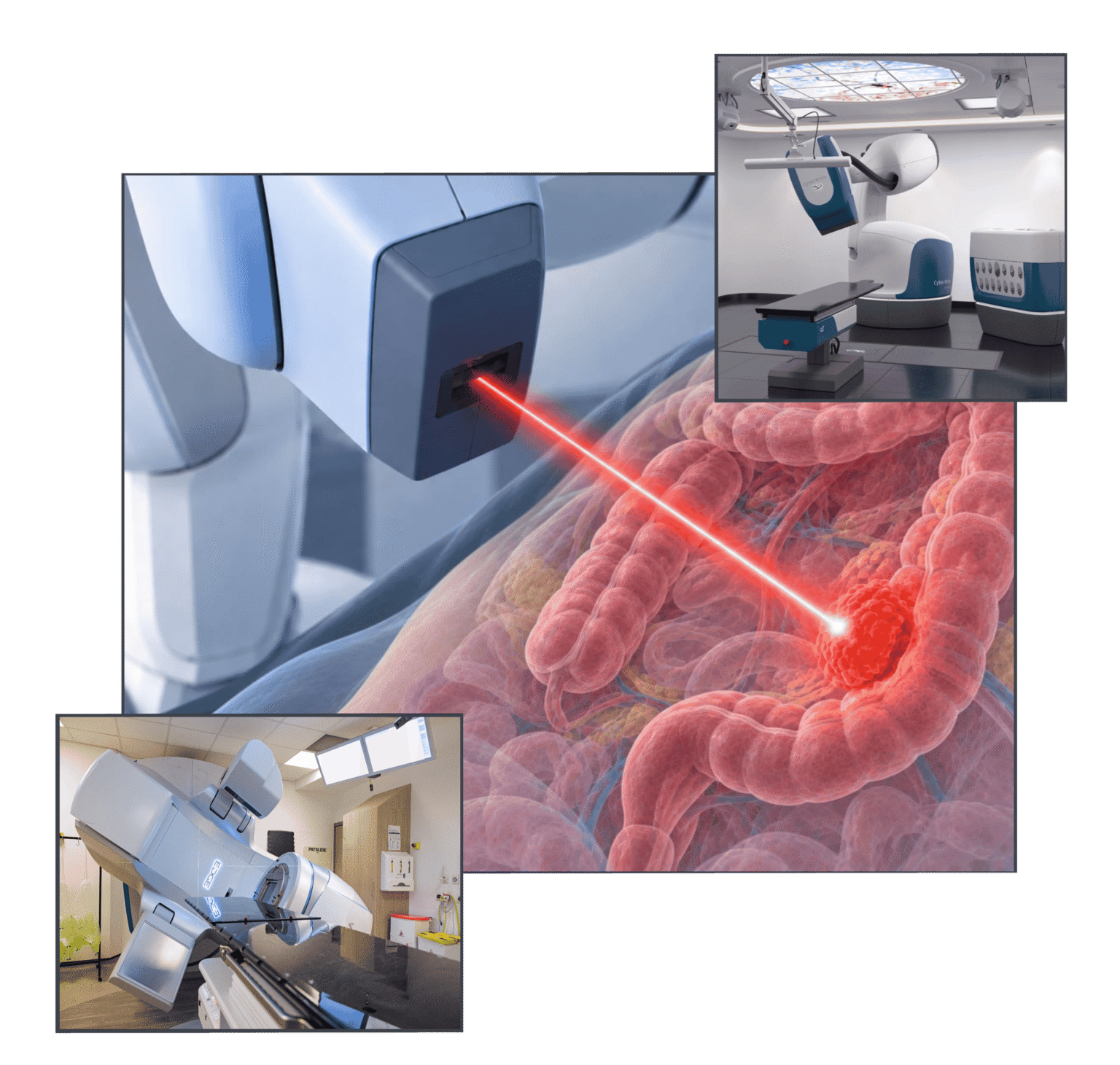
Every SABR treatment begins with detailed planning. Scans map the exact size and position of the tumour, along with the bowel, bladder and other structures nearby, so the radiation dose can be concentrated tightly on the cancer itself.
This precision is what allows SABR to be used for colon tumours in situations where surgery carries too much risk, and for cancer that has come back in the pelvis or abdomen after earlier treatment. Rather than repeating an operation, the tumour is treated directly with a short, targeted course of radiotherapy.
- CyberKnife: robotic guidance for sub-millimetre precision
- Linear Accelerator (Linac): high-energy radiation shaped to the tumour
- MR-Linac: real-time MRI guidance during treatment
THE BENEFITS OF SABR FOR Colon CANCER
Why More Patients Are Exploring SABR Treatment for Colon Cancer
For people with colon cancer, the hardest part is often not knowing whether every reasonable option has been explored. This is especially true when surgery is not suitable, treatment has already been intensive, or scans show cancer in an area that needs a careful local approach.
SABR treatment for colon cancer is being explored by more patients because it offers a focused way to treat selected tumours without relying on a standard pathway alone. The decision is always individual. It depends on where the tumour is, previous treatment, overall health and whether SABR can be delivered safely.
- No Hospital Stay
- No Anaesthetic, No Incision
- A Short, Defined Course
- Suitable When An Operation Is Not
- A Route For Cancer That Has Returned
- Built Around Your Own Scans
Is SABR Right for You
When SABR Fits Into Colon Cancer Treatment
- The Spread Is Limited And Clearly Defined
- The Tumour Is Difficult To Remove Safely
- Colon Cancer Has Spread To The Liver
- Colon Cancer Has Spread To The Lung
- Previous Local Treatment Has Been Used
- One Area Is Growing Through Treatment
SIDE EFFECTS OF colon SABR
What To Expect After SABR Radiotherapy For Colon Cancer
Most side effects from SABR are related to the exact area being treated. A tumour close to the bowel, bladder, stomach or liver carries different risks from a tumour in another part of the body. This is why planning is based on detailed imaging before any dose is delivered.
Your specialist team will explain which effects are likely, which are rare, and what symptoms to report after treatment.
Short-Term Effects
- Tiredness or reduced energy
- Looser stools or temporary bowel upset
- Abdominal or pelvic discomfort
Longer-Term Effects
- Bowel irritation that lasts beyond treatment
- Rectal bleeding or blood in the stool
- Bladder irritation if the pelvis is treated
- AXA
- BUPA
- WPA
- Aviva
- Vitality
- Cigna
- No Obligation
- Clear Pricing
- Klarna Accepted
- Video Consultation
- Scan Review
- Scheduling Support
PAYMENT OPTIONS for SABRS
Clear Payment Guidance For Colon Cancer SABR
Whether treatment is covered by insurance or paid for privately, you should not be left guessing about costs. Once your scans and diagnosis have been reviewed, the team can explain the recommended treatment route and the likely fees involved.
Payment information is provided before treatment begins, giving you time to make a clear decision.
Getting started
The Route From First Contact To SABR Treatment for Colon Cancer
Is SABR painful during treatment?
How long does each SABR session take?
Will I be radioactive after SABR?
How soon does SABR start working?
Do I need a biopsy before SABR?
Frequently Asked Questions
We Know You Have Questions. Here Are The Honest Answers.
When you are facing cancer treatment, every question matters. The answers below cover what patients most often ask us, but they are only a starting point.
If you are unsure about anything, our team will take the time to understand your situation, explain things clearly and help you feel more informed about your options.
Speak to the Team
Connect With Our Clinical Team
Whether you have a specific question or simply want to understand your options, our team will provide clear guidance and an honest assessment of what treatment could look like for you.
You can reach us by filling in the contact form or calling us directly.