
SABR for Lung Cancer in the UK
A non-surgical treatment for Primary and Metastatic lung cancer
If you or someone you love is facing a lung cancer diagnosis, the weeks after hearing those words can feel overwhelming. You may feel you have run out of options, or that the treatments you have been offered are not enough.
SABR treatment for lung cancer is a highly targeted, non-surgical radiotherapy that treats both primary and secondary lung tumours, aiming to eradicate all visible disease while keeping side effects to a minimum. We understand where you are right now, and we are here to help.
Primary and Metastatic Cancer
SABR treats both early-stage lung tumours and cancer that has spread to the lungs
No surgery required
Targeted treatment aimed at destroying the tumour, without a general anaesthetic or hospital admission.
1 To 8 Outpatient Sessions
All sessions are delivered as an outpatient. You go home the same day and get on with life as normal.
What is Lung Cancer?
Understanding Your Diagnosis Before You Decide on Treatment
Almost every patient we see describes the same first few weeks after a lung cancer diagnosis: too much information, too many unfamiliar words, and not enough clarity about what any of it means for them. Put simply, it is the uncontrolled growth of abnormal cells, forming a tumour that can spread outside of the lung it if left untreated.
Before you can make a confident decision about your treatment, it helps to have a clear picture of what you are actually dealing with.
Here is what you need to know:
Common symptoms of lung cancer:
- A persistent cough lasting three weeks or more
- Breathlessness or wheezing
- Chest pain when coughing or breathing deeply
- Coughing up blood
- Recurring chest infections
- A hoarse or changed voice
- Persistent ache in the shoulder or arm
- Unexplained weight loss or fatigue
If any of these sound familiar, or if you have already received a diagnosis and want to understand your options, we are here to help.
The main types of lung cancer:
Non-small cell lung cancer (NSCLC)
The most common form, accounting for the large majority of cases. Generally slower growing and often treatable with curative intent.
Small cell lung cancer (SCLC)
Faster growing and more likely to have spread at the time of diagnosis. Affects a smaller number of patients but requires prompt treatment.
Secondary lung cancer
Cancer that has spread to the lungs from another primary site, such as the breast, bowel, kidney, or prostate. Also known as lung metastases.
Types Of Secondary Lung Cancer
Cancer can spread to the lungs from many different primary sites. While we treat patients with a wide range of diagnoses, the cancers we see most frequently include:
- Lung cancer
- Breast cancer
- Bowel cancer
- Kidney cancer
- Prostate cancer
- Melanoma
- Sarcoma
- Bladder cancer
- Thyroid cancer
Targeted treatments for lung cancer
The right treatment for lung cancer is not the same for everyone
The right treatment for lung cancer depends on the type, stage, and location of your tumour, as well as your overall health. Most patients are offered one or more of the following:
Stereotactic Radiotherapy (SABR)
A precise, high-dose radiotherapy that targets lung tumours in just one to five sessions, without surgery or a hospital stay. Used with curative intent for early-stage lung cancer and for lung metastases. Outcomes comparable to surgery, with minimal impact on daily life.
Surgery (Lobectomy)
Removal of part of the affected lung. Considered standard for many early-stage lung cancers in patients fit enough for a general anaesthetic and major operation. Recovery takes weeks to months, and lung function is permanently reduced. It is now rare to remove an entire lung.
Chemotherapy and Systemic Therapy
Drug treatments that travel through the body to target cancer cells. Often used for more advanced disease, or alongside surgery and radiotherapy. Targeted therapy and immunotherapy work in more specific ways, attacking particular mutations or activating the immune system to fight cancer.
Conventional Radiotherapy
Lower doses of radiation delivered daily over four to six weeks. Used for locally advanced lung cancer, often alongside chemotherapy. A widely available standard treatment.
What is SABR treatment for Lung Cancer
SABR for Lung Cancer Targets the Tumour Directly, in Just a Few Sessions
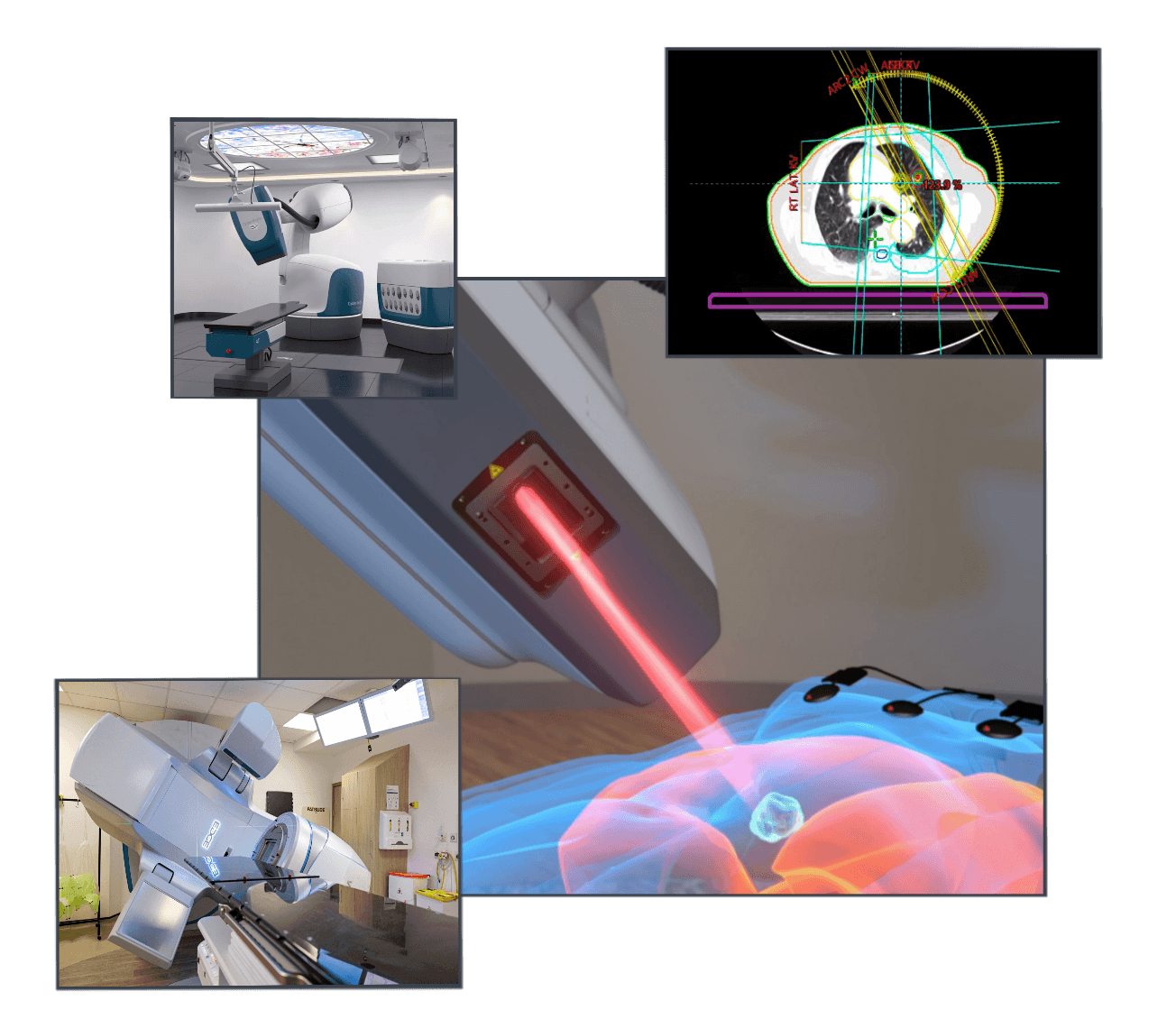
SABR delivers a high-dose, precisely targeted beam of radiation directly to the lung tumour. Before each session, advanced imaging confirms the exact position of the tumour, accounting for the natural movement of the lungs during breathing. The radiation is then shaped to match the tumour’s contours, concentrating the dose where it needs to go and minimising exposure to the surrounding tissue.
Treatment is delivered using one of three systems:
- CyberKnife: robotic precision for complex or hard-to-reach tumours
- Linear Accelerator (Linac): high-energy beams contoured to the tumour's shape
- MR-Linac: live MRI guidance throughout each session for maximum accuracy
The Benefits of SABR for Lung Cancer
What SABR gives patients that other treatments often cannot
Being told your lung cancer options are limited is one of the hardest things to hear. But limited options from one team does not always mean limited options everywhere.
SABR can treat early-stage lung tumours with genuine curative intent, and for patients with lung metastases it can target every visible site of disease individually, with the aim of eradicating it completely.
Some patients use it to reduce their reliance on ongoing chemotherapy. Others use it to get to a point where there is no evidence of disease on their scans at all.
Whether any of that is possible for you depends on your specific situation, and we will not know until we look at it properly.
Request a consultation and we will give you an honest answer, however that answer turns out.
- No surgery, no hospital admission
No incision, no anaesthetic, no recovery ward. SABR is an outpatient treatment. You arrive, receive your session, and go home the same day.
- A short treatment course
Most patients finish the full course in one to eight sessions. That is the entire treatment, not an ongoing commitment.
- Healthy lung tissue is protected
The dose is delivered precisely to the tumour, sparing the healthy lung tissue around it.
- Treats tumours in difficult locations
SABR can safely reach tumours near the heart, spine, and major airways, where surgery would carry too great a risk.
- Suitable when surgery is not
Patients who have been told surgery is not possible because of age, lung function, or general health are frequently suitable for SABR.
- Well tolerated by most patients
The treatment is painless. Most patients experience only mild, short-lived side effects afterwards. Serious side effects are uncommon.
Is SABR Right for You
The patients who benefit most from SABR Radiotherapy for lung cancer
Every patient we see comes with a different diagnosis, a different history, and a different set of questions. We do not offer a one-size-fits-all answer. What we do offer is an honest, individual assessment of whether SABR could make a real difference for you. If any of the situations below sounds familiar, it is worth having that conversation.
- You have early-stage lung cancer and want to avoid surgery
SABR treats stage 1 and 2 non-small cell lung cancer with potentially curative intent, without an operation. Outcome data is comparable to surgery.
- You have stage four lung cancer and have only been offered palliative care
SABR can target every visible site of disease, with the aim of reaching no evidence of cancer on your scans.
- You have been told you are not fit for surgery
Poor lung function is not a barrier to treatment. Even if age, lung capacity, or general health has ruled out surgery, SABR can still be delivered safely.
- You have lung metastases from another cancer
If cancer has spread to your lungs from another primary site, SABR can target each site individually, aiming to eradicate all visible disease.
- One or two spots are progressing while everything else is stable
Your treatment is working almost everywhere, but one or two sites are growing. SABR can treat those spots without disrupting what is otherwise working.
- Your chemotherapy is no longer working
If your current treatment has stopped being effective, SABR can target the active sites in your lungs while your team determines the next step.
side effects of lung SABR
What most patients experience during SABR treatment for Lung Cancer
We believe you should go into treatment knowing exactly what to expect. For most patients, side effects from lung SABR are mild and temporary. Many people carry on with their normal routine throughout the entire course of treatment.
Here is what patients receiving lung SABR most commonly report:
Common side effects
- Fatigue, usually easing within one to two weeks
- Mild skin irritation near the treatment area
- Temporary soreness around the treated site
Lung-specific side effects
- A mild cough or slight breathlessness
- Short-term inflammation in the lung tissue
- Occasional chest discomfort after a session
Serious complications are uncommon. Most patients finish treatment and return to daily life without significant disruption. If anything concerns you at any stage, our team is always here to help.
Many UK private health insurers cover SABR. Check with your insurer or their cancer helpline to find out if you are covered.
- AXA
- BUPA
- WPA
- Aviva
- Vitality
- Cigna
Self-funding gives you immediate access to specialist care, with no approvals and no delays. Every cost is agreed before treatment begins.
- Transparent Pricing
- No Hidden Costs
- Klarna Accepted
Patients travel to us from across the world for specialist SABR. We coordinate everything from your first enquiry to your final session.
- Scheduling Support
- Treatment Planning
- Clinician Liaison
Insurance & Payment Options
We will help you find a way to access the treatment you need
When you are dealing with a lung cancer diagnosis, the last thing you should be worrying about is whether you can access the treatment you need.
We have made it our priority to remove that barrier entirely. Whether you are insured, self-funding, or travelling from outside the UK, we will talk you through every option clearly and honestly before you make any decision.
After your consultation, all of this is discussed with you personally, so you can make your decision without any uncertainty or pressure.
Your Path To Treatment
Here Is What The Process Actually Looks Like
Most patients tell us that knowing what to expect makes everything feel more manageable. Here is how your journey with us unfolds, step by step.
Contact us by phone, email, or the form on this page. No referral needed. Our team will respond within one working day to discuss your situation and arrange a consultation.
You meet with one of our SABR specialists in person or by video call. They review your scans and medical history, explain your options, and give you an honest assessment.
If SABR is recommended, any additional imaging is arranged to give the team a complete and precise picture of the disease before planning begins.
Your treatment plan is built around your tumour, using 4D CT planning to account for movement as you breathe, reviewed by the full clinical team before treatment begins.
Treatment is delivered across one to eight short outpatient sessions, each entirely painless. Most patients drive themselves home afterwards.
Follow-up imaging monitors your response at regular intervals. Our team stays available between appointments and works closely with your wider oncology team throughout.
What is the success rate of lung cancer SABR?
Every case is different. For early-stage lung cancer, SABR has a high cure rate. Your specialist will walk you through what the evidence means for your individual diagnosis.
How does SABR differ from traditional radiotherapy?
Traditional radiotherapy delivers lower doses across many sessions, often over six to seven weeks. SABR delivers a much higher, precisely shaped dose in one to eight sessions, targeting the tumour directly while sparing surrounding tissue. The result is a shorter treatment course, fewer side effects for most patients, and in suitable cases, a higher chance of local control.
What cancers can SABR treat?
SABR can be used to treat primary lung cancer, as well as secondary cancers that have spread to the lungs from other sites including the breast, bowel, kidney, prostate, and melanoma. It is also used to treat metastases elsewhere in the body, including the liver, spine, adrenal glands, and lymph nodes.
Will SABR affect my breathing?
Most patients experience only mild, temporary effects. Some notice a slight cough or brief breathlessness as inflammation settles in the weeks after treatment. Severe lung complications affect fewer than two in every hundred patients.
Is SABR painful?
No. The treatment is entirely painless. Some patients experience mild soreness around the treated area for a few days afterwards, manageable with standard pain relief.
Frequently Asked Questions
We Know You Have Questions. Here Are The Honest Answers.
There is no such thing as the wrong question when you are facing a cancer diagnosis. Here are the questions we are asked most often, but do not let that limit you.
If something is on your mind, reach out to us whenever you feel ready. We will take the time to go through your situation with you, answer every question honestly, and make sure you leave the conversation with a clearer picture of what is possible.
Speak to the Team
Connect With Our Clinical Team
Whether you have a specific question or simply want to understand your options, our team will provide clear guidance and an honest assessment of what treatment could look like for you.
You can reach us by filling in the contact form or calling us directly.