
SABR TREATMENT FOR Brain METASTASES IN THE UK
Focused Radiotherapy
For Secondary Tumours
In The Brain
Brain metastases do not always mean that active local treatment is out of reach. For patients with a small number of lesions and disease that is otherwise manageable, stereotactic radiosurgery offers a direct, non-surgical way to treat each site with a high degree of accuracy.
SABR delivers focused, high-dose radiotherapy directly to each brain metastasis while protecting the surrounding healthy brain tissue. This page explains when it may be considered and what the assessment process involves.
No Brain Surgery Required
Treatment is delivered externally with no incision or inpatient admission.
Outpatient Treatment
Each session is attended as an outpatient appointment with no overnight admission required.
Preserves Healthy Brain Tissue
Dose is shaped tightly around each metastasis to limit exposure to surrounding brain.
WHAT ARE BRAIN METASTASES?
Understanding What It Means When Cancer Spreads To The Brain
Brain metastases develop when cancer cells from another part of the body cross into the brain and form one or more secondary tumours. They are separate from primary brain tumours such as gliomas and are treated according to the cancer that produced them, not as a new brain cancer diagnosis.
The brain is surrounded by a protective barrier that many cancer cells cannot cross. When they do, the clinical picture changes. The number of metastases, their size and location, and the state of the disease elsewhere in the body all shape the treatment decisions that follow.
Common Symptoms Of Brain Metastases
- Headaches that are new, persistent or different in character
- Nausea or vomiting, particularly in the morning
- A seizure occurring for the first time
- Weakness, heaviness or clumsiness on one side
- Speech difficulties or problems understanding language
- Memory lapses or uncharacteristic confusion
- Visual disturbance in one or both eyes
- Loss of balance or unsteady walking
- Fatigue or reduced ability to concentrate
Not all brain metastases cause symptoms when first discovered. When symptoms do appear, they reflect the area of the brain affected and should always be investigated in the context of a known cancer diagnosis.
The main types of Brain Metastases
Parenchymal Metastases
Cancer has spread into the brain tissue itself. This is the most common form and can occur as a single lesion or as multiple deposits in different parts of the brain.
Leptomeningeal Metastases
Cancer has spread to the membranes surrounding the brain and spinal cord. This is a more complex presentation that requires a different treatment approach from localised brain metastases.
Solitary Brain Metastasis
A single metastasis is present with no other brain involvement. This pattern may allow a more focused local treatment approach.
Multiple Brain Metastases
More than one lesion is present. The number, size and distribution of lesions all influence which treatment options are appropriate.
Primary Cancers That Spread To The Brain
Several primary cancers are known to spread to the brain, with lung cancer accounting for the highest proportion in published series.
The primary cancer type affects how brain metastases behave, how they respond to treatment and what systemic options remain relevant.
- Lung cancer
- Kidney cancer
- Breast cancer
- Colorectal cancer
- Melanoma
TREATMENT OPTIONS FOR brain METASTASES
How Brain Metastases Are Treated And What Each Option Involves
Not all brain metastases are managed the same way. The number of lesions, where they sit and what systemic treatment is already in place all determine which options are appropriate and in what order.
Stereotactic Radiotherapy (SABR)
Focused, high-dose radiotherapy delivered to individual brain metastases over one to five sessions. Used when lesions are discrete and limited in number, preserving surrounding healthy brain tissue.
Whole Brain Radiotherapy (WBRT)
Radiotherapy delivered to the entire brain. Used when metastases are numerous or widespread. Associated with cognitive side effects and generally considered when localised treatment is not appropriate.
Neurosurgery
Surgical removal of a brain metastasis. Considered for single, accessible lesions causing significant symptoms or mass effect, particularly when tissue is needed for diagnosis.
Systemic Therapy
Targeted therapy, immunotherapy or chemotherapy directed at the primary cancer. Some agents cross the blood-brain barrier and may have activity against brain metastases depending on the primary cancer type and molecular profile.
Corticosteroids
Dexamethasone is used to reduce cerebral oedema and manage symptoms caused by brain metastases. It is not a treatment for the metastases themselves but an important part of symptom management.
Active Surveillance
Regular MRI monitoring of small, asymptomatic brain metastases without immediate intervention. Appropriate in selected patients when lesions are stable and not causing neurological symptoms.
WHAT IS SABR TREATMENT FOR BRAIN METASTASES
Precise, Individualised Radiotherapy For Brain Metastases
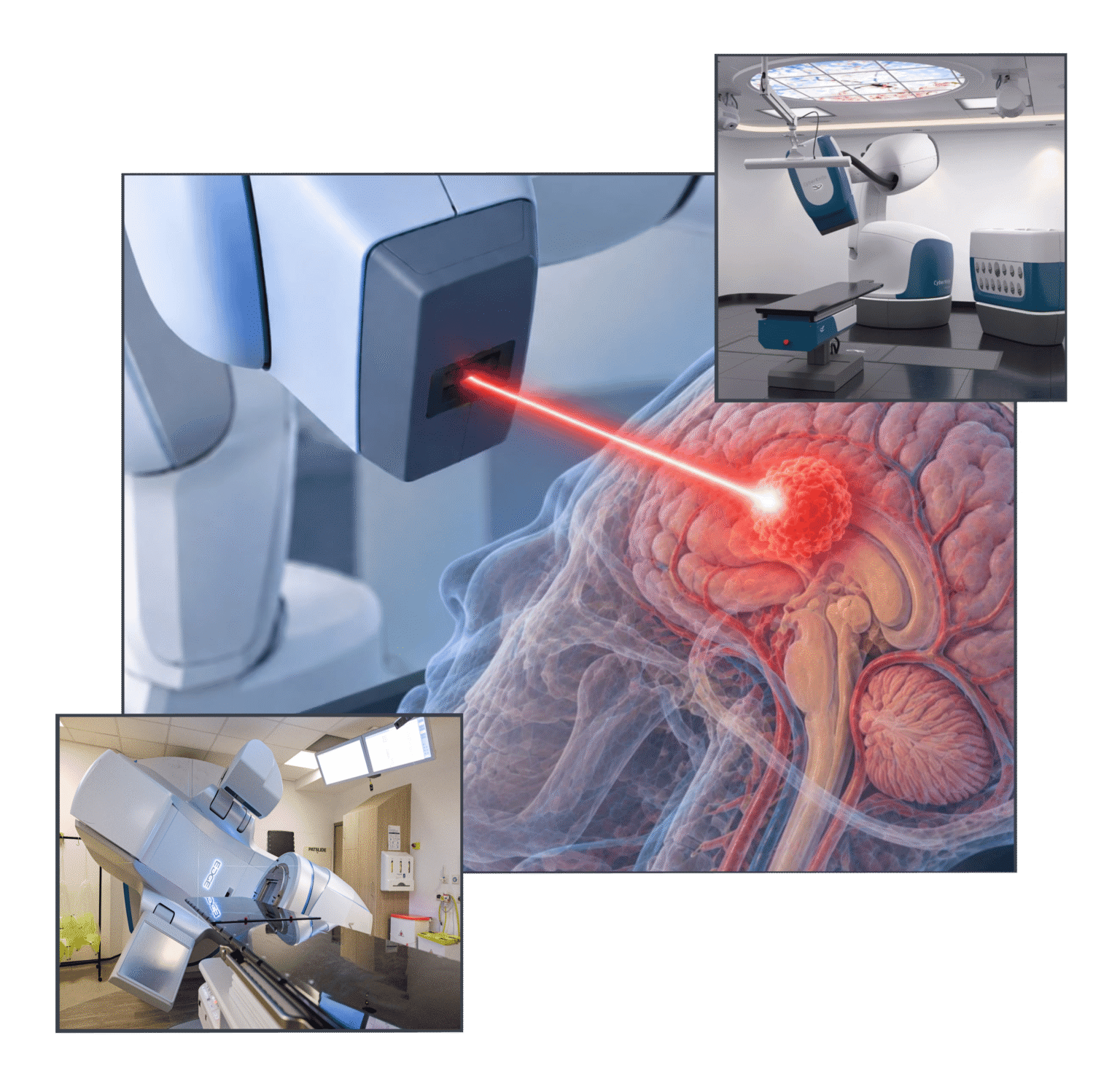
SABR uses advanced imaging to map the exact size and position of each brain metastasis and deliver a focused, ablative dose directly to it. Because the dose is concentrated on the target, the surrounding brain receives substantially less radiation than with conventional whole brain treatment.
Immobilisation and image verification are central to brain SABR. Each session begins with imaging to confirm the position of the lesion before any radiation is delivered.
Dose constraints to the brainstem, optic nerves and other critical structures are defined during planning and respected throughout treatment.
- CyberKnife: precise robotic delivery with real-time positional verification
- Linear Accelerator (Linac): shaped, image-guided beams targeted to each metastasis
- MR-Linac: superior soft tissue visualisation during planning and treatment
THE BENEFITS OF SABR FOR BRAIN METASTASES
Why SABR Is Considered For Secondary Brain Tumours
When brain metastases are limited in number and clearly defined on imaging, SABR offers a way to treat each lesion directly without exposing the whole brain to radiation.
Critical structures including the brainstem, optic chiasm and cochlea are identified during planning, and dose constraints to these areas are built into every treatment plan.
The clinical evidence supports this approach in patients with oligometastatic brain disease. Treating lesions individually rather than the whole brain has been shown to reduce the risk of treatment-related cognitive decline while maintaining effective local control at each treated site.
- Targets Each Lesion Individually
Treatment is planned and delivered to each metastasis separately, based on its precise position and dimensions.
- Protects Critical Brain Structures
Dose limits to the brainstem, optic pathways and cochlea are defined and respected throughout planning.
- Reduces Risk Of Cognitive Decline
Avoiding whole brain irradiation lowers the risk of memory and concentration problems after treatment.
- No Operation Required
Treatment is delivered entirely from outside the body without surgery or anaesthetic.
- Completed Over Few Sessions
Brain SABR is typically delivered in one to five outpatient visits, depending on the number of lesions and complexity of the plan.
- Supports Ongoing Systemic Treatment
The short treatment course rarely requires a meaningful pause in drug therapy.
IS SABR RIGHT FOR YOU
Which Patients With Brain Metastases May Benefit From SABR
SABR is a selective treatment for brain metastases, considered when imaging allows each lesion to be planned and treated safely within accepted dose constraints.
- A Limited Number Of Brain Metastases
SABR is most relevant when lesions are few in number and each can be individually targeted and planned.
- Each Lesion Is Clearly Visible On MRI
A discrete, measurable target confirmed on contrast-enhanced MRI is required before planning can begin.
- Isolated Progression At A Single Site
Local treatment of the progressing site may allow effective systemic therapy to continue unchanged.
- Surgery Is Not Appropriate Or Not Preferred
Where neurosurgical resection carries too much risk, SABR provides a non-surgical option for local control.
- Ongoing Systemic Treatment Can Continue
SABR can often be coordinated around targeted therapy or immunotherapy without a prolonged pause.
- Treatment Planned Around Critical Structures
Each plan must demonstrate that the brainstem, optic pathways and sensitive structures remain within safe dose limits.
SIDE EFFECTS OF SABR FOR BRAIN METASTASES
What You May Notice AfterBrain SABR
Treatment is delivered without discomfort. Side effects typically emerge within the first two to four weeks after the final session and reflect the brain’s response to a focused, high dose of radiation at the treated site.
Because SABR limits dose to the surrounding brain, the side effect profile is generally more favourable than that of whole brain radiotherapy, though localised effects remain possible.
Short-Term Effects
- Fatigue in the weeks following treatment
- Headache from cerebral oedema around the treated lesion
- Temporary increase in pre-existing neurological symptoms
- Scalp sensitivity or localised hair thinning at the treatment site
- Nausea, which may occur in the first few days
Longer-Term Effects
- Radiation necrosis at the treated site in approximately 5–10% of patients
- Memory and concentration changes in a small number of patients
- Permanent localised hair loss at the beam entry point
- Late seizures occurring in a small number of patients
- Hearing changes in lesions close to the cochlea
Serious late effects are uncommon when planning constraints are respected. New neurological symptoms after treatment should always be assessed without delay.
SABR treatment may be covered by your private health insurance, either in full or in part, depending on your policy and insurer approval.
- AXA
- BUPA
- WPA
- Aviva
- Vitality
- Cigna
Paying privately means treatment can be arranged without insurer approval. You will be given clear costs upfront, including what is included.
- Time To Decide
- No Hidden Fees
- Klarna Accepted
From first consultation to planned treatment, the team helps organise the details of your visit.
- Video Consultation
- Scan Review
- Treatment Scheduling
SABR Treatment Costs And Payment Options
Simple Payment Options For Specialist SABR Treatment
Patients come to us through different routes. Some use private health insurance, some choose to self-fund, and others travel from outside the UK for specialist cancer care.
We aim to make each route as straightforward as possible, with clear information about costs and payment options provided after consultation, once your treatment plan has been assessed.
Getting started
From Assessment To SABR Treatment
The pathway gives you clarity at every step, from understanding your options to planning treatment and monitoring progress.
Get in touch by phone, email or the form on this page. You do not need a referral to enquire. Someone from the team will be in contact within one working day.
In your consultation, a SABR specialist goes through your imaging and background, answers your questions and gives you a clear, honest picture of what is possible.
If further scans are required before treatment can be planned, these are arranged so the full extent of the disease is clearly understood.
The plan is built specifically for your case. 4D CT planning accounts for natural movement during breathing, and the full clinical team reviews everything before treatment is approved.
Each session is short, painless and delivered as an outpatient appointment. Most patients need between one and eight sessions in total and are able to drive home after each one.
Follow-up scans and clinical review are scheduled at regular intervals after treatment to assess how the treated area is responding and to guide decisions about what comes next in your care.
How is radiation necrosis treated if it occurs?
Mild cases are often monitored with regular MRI. Where symptoms develop, corticosteroids are the first line of management. In more persistent cases, bevacizumab has been used to reduce necrosis-related oedema. Surgical removal is occasionally required.
Does the primary cancer type affect how well SABR works on brain metastases?
Yes. Melanoma and renal cell carcinoma, for example, tend to be more radioresistant than breast or lung cancer metastases. This influences dose selection and how closely response is monitored after treatment.
Can SABR treat a brain metastasis that has already been surgically removed?
Yes. SABR to the surgical cavity is a recognised approach used to reduce the risk of local recurrence after resection. It is planned using post-operative MRI and targets the cavity rather than a residual lesion.
Will I be awake during treatment and do I need to keep still?
Yes, treatment is delivered while you are awake. You will be positioned using a personalised immobilisation mask to minimise movement. The mask holds your head in a fixed position so that each beam is delivered accurately throughout the session.
Is there a minimum gap required between brain SABR and systemic treatment?
This depends on the drug. Some targeted therapies and immunotherapy agents can continue without interruption. Others require a short pause around the time of treatment to reduce the risk of enhanced toxicity. Your oncologist will advise based on your specific regimen.
Frequently Asked Questions
We Know You Have Questions. Here Are The Honest Answers.
When you are facing cancer treatment, every question matters. The answers below cover what patients most often ask us, but they are only a starting point.
If you are unsure about anything, our team will take the time to understand your situation, explain things clearly and help you feel more informed about your options.
Speak to the Team
Connect With Our Clinical Team
Whether you have a specific question or simply want to understand your options, our team will provide clear guidance and an honest assessment of what treatment could look like for you.
You can reach us by filling in the contact form or calling us directly.